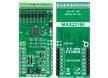

MIKROE-5168

Mikroe
932-MIKROE-5168
MIKROE-5168

Herst.:

Beschreibung:
Schnittstellen-Entwicklungstools I2C MUX 6 Click

Auf Lager: 4

Lagerbestand:
4 sofort lieferbar
Lieferzeit ab Hersteller:
10 Wochen Geschätzte Produktionszeit des Werks für Mengen, die größer als angezeigt sind.
Minimum: 1   Vielfache: 1
Stückpreis:
€ -,--
Erw. Preis:
€ -,--
Vorauss. Zolltarif:

Preis (EUR)

Menge Stückpreis
Erw. Preis
€ 12,04 € 12,04

Produktattribut Attributwert Attribut auswählen
Mikroe
Produktkategorie: Schnittstellen-Entwicklungstools
RoHS:  
Add-On Boards
I2C
PCA9518
Marke: Mikroe
Abmessungen: 42.9 mm X 25.4 mm
Maximale Betriebstemperatur: + 85 C
Minimale Betriebstemperatur: - 40 C
Betriebsversorgungsspannung: 3.3 V
Produkt-Typ: Interface Development Tools
Verpackung ab Werk: 1
Unterkategorie: Development Tools
Produkte gefunden:
Um ähnliche Produkte anzuzeigen, wählen Sie mindestens ein Kontrollkästchen aus
Um ähnliche Produkte in dieser Kategorie anzuzeigen, wählen Sie mindestens ein Kontrollkästchen oben aus.
Ausgewählte Attribute: 0

CAHTS:
8543700000
USHTS:
8543709860
JPHTS:
854370000
ECCN:
EAR99

I2C MUX 6 Click

Mikroe I2C MUX 6 Click represents a bidirectional selector dedicated to I2C slave address conflicts applications. The board features the Texas Instruments PCA9518  expandable five-channel bidirectional buffer controlled by the I2C-bus. The PCA9518 overcomes the restriction of maximum bus capacitance by separating and buffering the I2C data (SDA) and clock (SCL) lines into multiple groups of 400pF I2C channels. It provides activation of the desired channel via a given Enable pin and permits extension of the I2C-bus, through an onboard expansion header, by buffering both the data (SDA) and the clock (SCL) lines enabling virtually an unlimited number of buses of 400pF.

Interface Click Boards

Mikroe Interface Click Boards are used to add new interfaces to boards for applications and designs. Mikroe Click Boards are based around the mikroBUS™ interface standard and easily add incredible system capabilities. The devices include interfaces like Ethernet, USB, and Fiber Optics, to name a few.